
How to Size a Generator for Your Home Before Winter Outages
Add up running and starting watts, pick the right generator size, and set it up safely with CO and backfeed precautions before the next outage.
 Save
The right generator size is the total running watts of everything you want powered at once, plus the extra surge needed to start the largest motor. Add those numbers, then choose the nearest larger generator. Do it before the first winter storm, and set the machine up outdoors, away from the house, so carbon monoxide stays out of your home.
Quick answer
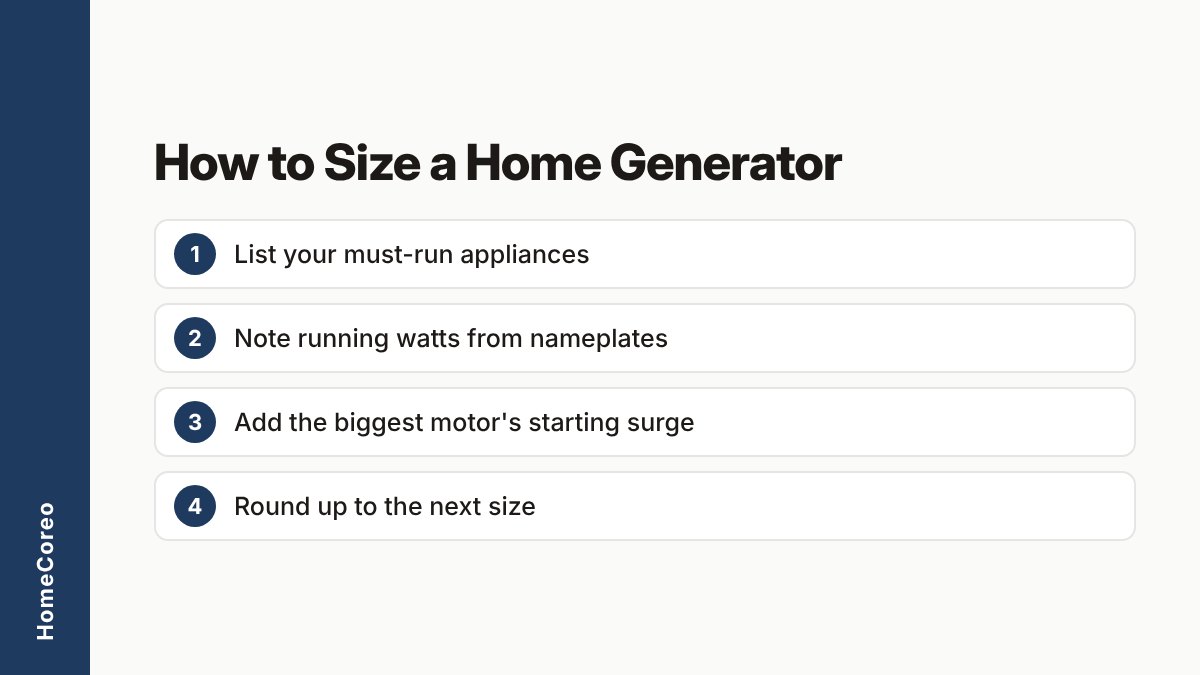
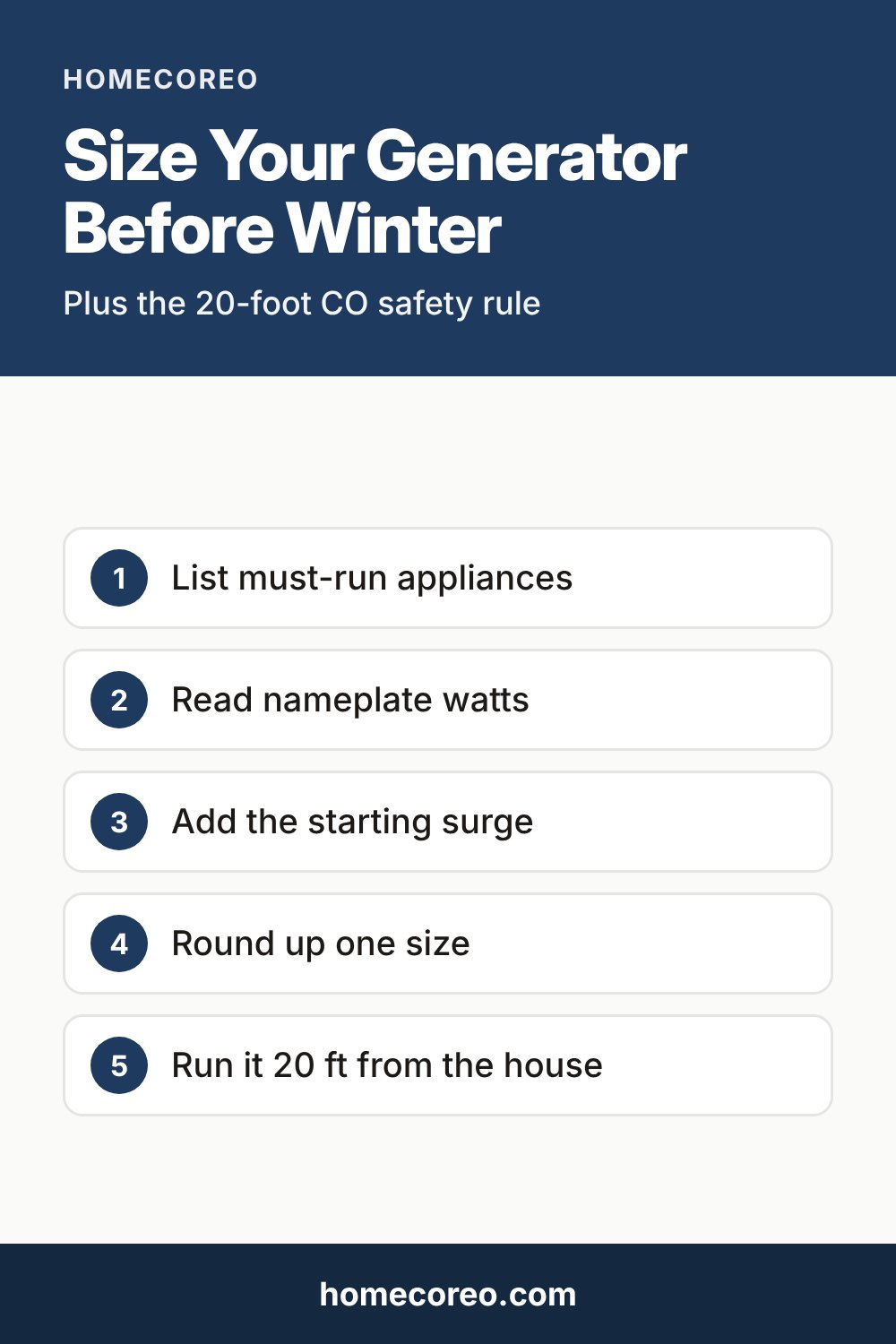
- List what you must keep running (refrigerator, freezer, furnace blower, well pump, lights).
- Find each item’s running watts on its nameplate.
- Add the running watts of everything that will run at the same time.
- Add the extra starting watts of the largest motor.
- Pick the nearest generator size above that total.
Running watts vs starting watts
Running watts are what an appliance draws once it is operating. Starting watts are the short surge a motor needs to get going. A general rule from university extension guidance is that motors need about four times as much power to start as they do to run. A motor that runs at 400 W may need about 1,600 W for a moment to start.
Heating elements and lights draw about the same at start as they do while running. Compressors, pumps and fan motors are the ones that surge.
Typical wattage ranges
If the nameplate does not list watts, an estimate is a reasonable start. Treat these as ballpark figures and check your own labels.
| Appliance | Typical running watts |
|---|---|
| Refrigerator | 400-800 W |
| Freezer | 600-1,000 W |
| Furnace blower | 400-600 W |
| Well water pump | 800-2,500 W |
Motors listed in horsepower can be converted to watts using a conversion table. For example, a 1/2 hp motor takes about 575 W to run and 2,300 W to start. A 1 hp motor takes about 1,000 W to run and 4,000 W to start.
What you need
- A pen and paper (or a spreadsheet) for your list
- The nameplates of your essential appliances
- A tape measure, to plan the 20-foot clearance from the house
- A battery-powered or battery-backup carbon monoxide (CO) alarm for every level of the home and outside sleeping areas
Step-by-step: size your generator
- Choose your essentials. Start with food storage, heat (furnace blower or controls), water (if you have a well pump), and a few lights. Add comfort items only if there is spare capacity.
- Write down running watts. Read each nameplate. Use the typical ranges above only when a label is missing.
- Decide what runs together. You do not have to start everything at the same moment. Staggering large motors lowers the surge you need.
- Add the running watts. Total everything that will be on at the same time.
- Add the largest starting surge. Take the biggest motor’s extra starting watts and add them to the total.
- Round up. Choose the nearest larger generator rather than the nearest smaller one.
Worked example
A refrigerator (800 W) and a freezer (1,000 W) that both try to start at once could need about 1,800 x 4 = 7,200 W. If they will not start at the same time, about 4,800 W is enough: 800 W running for the refrigerator plus 4,000 W to start the freezer. Staggering the motors cuts the size you need.
Set it up safely
Carbon monoxide
Portable generators can produce a large amount of carbon monoxide, an odorless gas. Federal safety data link more than 100 deaths a year in the US to portable generators. Follow these rules every time:
- Run the generator outdoors only, at least 20 feet from the house, with the exhaust pointing away from doors, windows and vents.
- Never run it in a garage, basement, crawl space or shed, even with doors or windows open.
- Keep working CO alarms in the home while it runs, and check their batteries.
- Know the symptoms: headache, dizziness, weakness, upset stomach, vomiting, chest pain and confusion, which can feel like the flu. Sleeping people can be harmed before symptoms appear. If anyone feels these, get outside to fresh air and seek emergency help.
Electrical safety
- Never plug a generator into a wall outlet. That can send power back into utility lines.
- To power household circuits, use a properly installed transfer switch, installed by a qualified electrician under local electrical code and utility rules.
- Use outdoor-rated extension cords that are thick enough for the load, and keep cords and the generator out of rain and standing water.
- Let the engine cool before refueling, and store fuel outside living areas.
Plan your outage load list
Writing the list before a storm saves guesswork when the lights go out. Sort items into three groups so you can decide quickly what to run and when.
- Must run: food storage, the furnace blower or heating controls, a well pump if you have one, and a few lights.
- Run in turns: large motors you can alternate, such as a sump pump or a second freezer, so their starting surges do not stack.
- Skip for now: big heating elements and other high-draw items that would force you into a much larger generator.
Keep the finished list with the generator and update it when you replace a major appliance. A newer refrigerator may draw less than an old one, and a new well pump can draw more.
Fuel and run-time basics
Size is only half of the plan. A generator that cannot run long enough on stored fuel will not help in a multi-day outage. Check the manufacturer’s manual for fuel type, tank size and run time at partial load. Store fuel only in approved containers, outside the living space, away from ignition sources. Let the engine cool before you refuel, and never refuel a running unit.
Test the generator before you need it. A short run under load shows whether it starts, whether the outlets work, and whether your cords reach the places you planned while keeping the unit 20 feet or more from the house.
Common mistakes
| Mistake | Why it hurts | Better approach |
|---|---|---|
| Adding only running watts | Motors cannot start | Add the largest starting surge too |
| Running it in the garage | CO can build up | Outdoors, 20 feet or more away |
| Buying the smallest unit that fits | Overload risk | Round up to the next size |
| Skipping CO alarms | No warning | Alarms on every level and outside bedrooms |
| Backfeeding through an outlet | Danger to line workers | Use a transfer switch |
When to call a professional
Call a licensed electrician for a transfer switch or inlet box, any change to your electrical panel, or if you are unsure about the right size for a well pump or large heating system. Ask about permits and inspection in your area.
Sources
 Save
Frequently asked questions
Can I run a generator in the garage with the door open?
No. Open doors and windows do not make indoor or garage use safe, because carbon monoxide can still build up and drift into the living space. Run it outdoors, at least 20 feet from the house, with the exhaust pointed away.
What happens if my generator is too small?
Motors such as refrigerators may try to start but the voltage drops, and the motors can overheat and burn out. It is better to size up than to overload a unit.
Why does the starting wattage matter so much?
Motors need roughly four times as much power to start as they do to run. Your generator must cover that brief surge for the biggest motor on the circuit.
Do I need a transfer switch?
If you want to power household circuits instead of plugging appliances into the generator, yes. A properly installed transfer switch keeps power from feeding back into utility lines, which could injure neighbors or utility workers.